3.4.26
Measles is back in ND...again... Now what?
2/27/20264 min read
With multiple cases now present in ND, please be aware that measles could happen in Kidder County at any moment. Please be prepared. For the most up to date information please visit https://www.hhs.nd.gov/immunizations/measles. You can view an updated dashboard as well as any information needed.
General measles information:
· The initial symptoms of measles are non-specific: cold symptoms. Then after a few days white spots appear in the mouth followed by a rash that starts on the head/face (think hairline) and spreads down. This usually coincides with a high fever (104ish). While many claim measles is “a mild illness” it can become severe, keep reading!
· Measles is HIGHLY contagious. 90% of unvaccinated people exposed to an active case develop measles. It’s transmitted through airborne droplets (very tiny – surgical masks do not work for these tiny droplets) and can linger in the air for 2 hours since an infected person was present!
· Measles is contagious for four days before the rash onset until four days after the rash onset.
· There is no treatment for measles other than helping symptoms through rest, hydration, and over the counter medications.
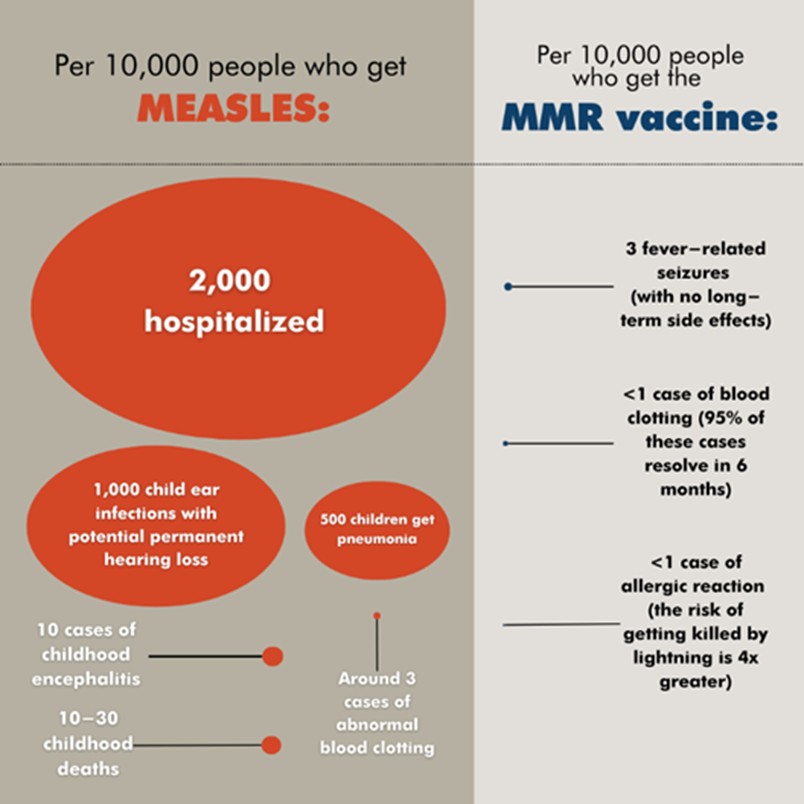
· About 1 in 5 people (20%) infected with measles will be hospitalized.
· Even with access to modern healthcare, measles can be deadly: 1 to 2 out of every 1,000 people with measles will die.
· Serious complications include:
o Pneumonia (1 in 500 cases)
o Encephalitis (brain swelling) (1 in 1,000 cases)
o Permanent cognitive disability (rare but irreversible)
o Immune suppression similar to HIV/AIDS, which destroys the body’s ability to fight future infections
What happens if I’m exposed?
· If you have had one dose of MMR vaccine: you are 93% protected. 2 doses = 97%. You do not need to quarantine. It’s rare you would contract measles - if you did, the case is typically more mild.
· If you were born before 1957 you are assumed immune due to the widespread nature prior to vaccination.
· Unvaccinated people who are exposed to measles need to quarantine (stay home) for 21 days after last exposure. This includes school children. This is per NDCC.
· If cases start occurring in ND and in our county and you are not vaccinated, please be vigilant. If your children are sick with suspected measles, stay home to avoid spreading it and be sure your child stays hydrated! - if they need medical care, call ahead so they can give you instructions to limit the exposure to others.
· The website listed at the start of this article will have a listing of exposure sites so the public can know if they were exposed. We will also share this in real time on our Facebook page.
MMR Vaccine
· Vaccination rate in Kidder County for children 1-19 who are up to date on the MMR vaccine = 81.4%. Up to date rate at Kidder County school is overall is 89.6%, with elementary school at 85.7%, high school at 95.1%. Rates are far below the 95% threshold needed for community protection (herd immunity) and have steadily decreased each year.
· The only practical way to prevent measles is through vaccination. This deserves repeating: without immunization, a person exposed to measles has a 90% chance of developing the disease. Exposure can happen even after someone has left an area since the virus stays airborne for up to two hours after an infected person has left an area.
· Again, one dose of MMR vaccine is over 93% effective, and two doses of vaccine are over 97% effective at protecting against measles.
· The MMR vaccine was first introduced in 1963. The current vaccine has been used since 1971 and has been given to millions of people worldwide.
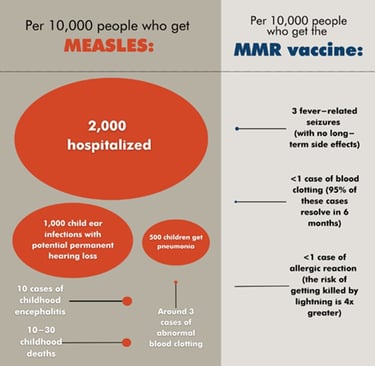
· Despite what is circulating on social media, its safety is backed by more than 100 independent studies and decades of real-world use. (see graphic)
· Kidder County District Health Unit ALWAYS has MMR doses on hand. If you are unsure of your or your child’s vaccination status or are unsure if you are recommended to receive the vaccine please call us 475-2582.
Nuances – nothing is ever straight forward
· Understanding Immunity By Age:
o Adults born after 1963 and vaccinated before 1968 may have received an inactivated measles vaccine, which was less effective. These individuals should consider getting another MMR dose.
o Adults born in 1968 or later should have at least one dose of MMR vaccine.
• Two doses are recommended for:
• College students
• International travelers
• Healthcare personnel
• Close contacts of immunocompromised individuals
• People with HIV
Special recommendations for children:
Children 6–11 months old traveling internationally or to outbreak areas (counties in ND with cases) should receive an early MMR dose.
This early dose is safe but does not count toward the regular two-dose series.
These children will still need two additional doses starting at age 12 months.
Children over 12 months traveling to outbreak areas should get their second MMR dose early, at least 28 days after the first dose.
These measures help protect children during periods of high risk.
Frequently asked questions:
Insurance Coverage for Early MMR Doses
ND Medicaid, Blue Cross Blue Shield of North Dakota, and Sanford Health Plan all cover MMR vaccine starting at 6 months of age.
If you have questions, contact your insurance provider directly.
Why Not Vaccinate Before 12 Months Routinely?
It’s not about safety; it’s about effectiveness.
Babies still carry maternal antibodies, which can interfere with how well the vaccine works.
The immune system also becomes more mature after 12 months, which helps build strong, lasting protection.
In outbreak situations, the benefit of early protection outweighs the need to wait—hence the early dose recommendation.
Addressing Concerns: Do MMR Vaccines Contain Fetal Stem Cells?
No. MMR vaccines do not contain fetal stem cells.
The vaccine virus is grown in fetal-derived cells, but these cells are not in the final product.
According to the Children’s Hospital of Philadelphia:
The production process includes purification steps that remove all cellular debris and DNA.
It's like picking blueberries: you may collect leaves or stems, but you remove them before making the pie—leaving only the essential ingredients.
Religious leaders, including those from the Catholic Church, have reviewed this process and affirmed that receiving vaccines made in this way is ethically acceptable.
Please reach out to us with any questions – Kidder County District Health Unit 475-2582. Visit our website www.kiddercountyhealth.com or our Facebook page facebook.com/KCDHU. We are always happy to help!