1.20.2026
Hear my story: How my life experiences shaped who I am as a nurse
1/16/20265 min read
We all have a story to tell. Our unique experiences shape who we are, what we believe, and how we act in society – they form our perspective of the world and the decisions we make. Think of decisions you have made based on your past experiences…where you shop or eat, what you wear, what you drive. We all carry perspective. This is mine – what shaped me into the nurse I am today, why I work in public health, and what shaped my perspective on vaccines.
Let’s go back to Nursing School – 2009ish. I remember our professor mentioning measles, but we didn’t truly learn about it. “It’s been eradicated in the US and there is an effective vaccine that will prevent it from coming back.” Essentially, no point in teaching about it. Things have changed – the US will likely lose it’s “eradication status” in 2026 since US measles cases top 2,000 and the outbreaks have been happening for over a year. Why? Decreased vaccination rates, distrust in vaccines, and also a generation of parents (millennials and Gen Xers) who have never seen vaccine preventable diseases. Through my travels – I have. And I have also interacted with people who only wish they had access to vaccinations like we do here in the US. Hear my stories…
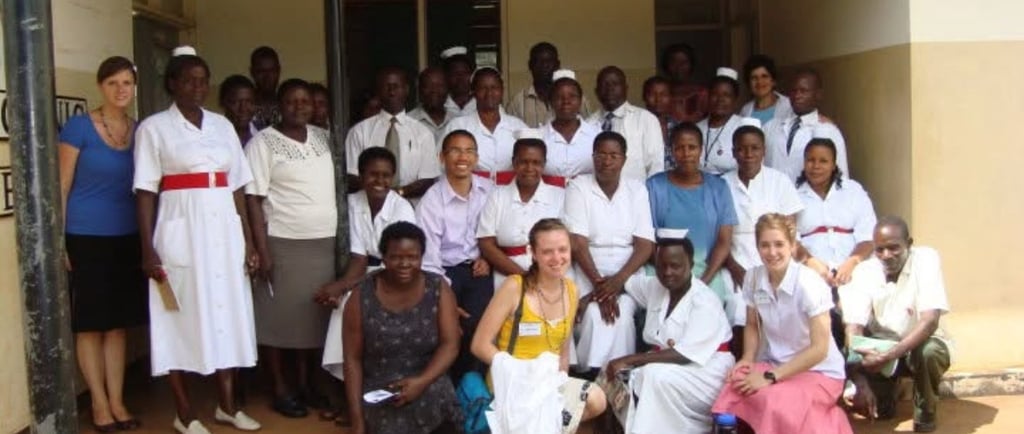
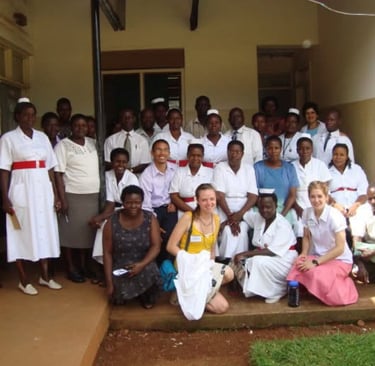
It's summer of 2010 and I just graduated nursing school at University of Wisconsin – Madison. I travelled with the School of Medicine and Public Health to sub-Saharan Africa for approx one month to learn more about population health. We lived on staff quarters at Kawolo Hospital in a small, rural town in Uganda: Lugazi. There’s one doctor for the whole hospital – Dr. Joshua Kibera. He walks with limp and a cane – he had polio as a child that left him with this lifelong challenge. We toured the wards where I heard of diseases that I only learned about in nursing school. One patient that sticks out in my mind is the young man dying of tetanus – a disease you rarely hear about in the US. His family was by his side, muscles tensed/seized, he looked uncomfortable but was unconscious. So often Dr. Joshua would say, and this is no joke, “you probably won’t see this in the US because of your vaccines and medicine.”
Access to these life-saving medications and vaccines is limited in rural Africa. Major strides had been made for vaccine access in previous decades – but much was funded through global efforts and USAID, which sadly have decreased. (Side note: I have a picture on my camera roll from that trip of a sign that says “USAID – from the American People.” So many people were so thankful to us for not just us coming to help them, but also for the US in general.) Even back in 2010, I remember helping nurses complete a well-baby clinic where they were giving vaccinations. The room was packed full, lines out the door, with so many women and children hoping they could get vaccinations, Vitamin A, and other medications that day. The Ugandan nurses “tsked” when they heard that not everyone gets vaccinated in the US (and this was 2010 – when rates were ok!) – since in Africa it was a given if you could get access to them.
Another side tangent: in this particular hospital in Lugazi as well as the Regional Hospital in Entebbe, family cared for the admitted patient. There might be one nurse for an entire ward, so it was commonplace to have family sleeping on floors next to their loved one and providing cares. Also, just because a doctor prescribed a medication, didn’t mean the patient would receive it – that depended on if the hospital had that medication in stock and then if the family could afford it, etc. I remember at Kawolo Hospital, they had a total of 2mg of dilaudid (a powerful pain medication) for the entire MONTH! (for perspective: a common dose of IV dilaudid in the US is 0.5-1mg every 2ish hours for pain while in the hospital). Imagine the reverse culture shock when I started my first nursing job in WI and more than that was wasted (had to legally waste with a witness) for partial doses on one shift and one hospital unit alone.
Now it’s September of 2019. I’ve been a nurse for almost a decade. I now live here in Kidder County and just landed a phenomenal job in our local public health office – Kidder County District Health Unit. I’m starting right as our busy Flu Vaccine season starts. I remember when I first heard vaccine stories from the senior residents I served – among other stories that shocked me from living in rural ND: the winter of 1966, no electricity till the 1950s, taking a horse drawn sled to school 5 miles away, etc. But one stands out in my mind: “She lost her whole family to the flu and then got remarried and had to start all over.” I cannot even imagine.
A previous co-worker always talked about her gratitude for vaccines because her child had haemophilus influenzae (Hib – a severe, invasive, bacterial form of influenza in young children) before the vaccine came out. He became very sick and was almost hospitalized had she not had her nurse training. Nowadays, parents don’t have to worry about that disease since it’s part of the vaccine schedule.
My medical director, Dr. David Field, talks about his early years in residency at St. Alexius Hospital and how children were dying of pertussis (whooping cough) at that time. As cases increased in 2024 and this year in ND, he became more vocal about his perspective and how those early years shaped him as a doctor. Now pertussis is a vaccine preventable disease and any death is avoidable.
Other voices echo in my brain - and the same stories are heard year after year. So many stories of “we all lined up at school and got our shots”, “you wanted to be the first in line so the needle was sharp”, “Dr. Z would come out to the house”, “she spent the summer in an iron lung at her house across the street.” Not everyone hears these stories; I feel honored that I have. And I learn from them. These stories are of real people – people that we know. Not just stories you hear online, not fabricated. And these stories need to be told – or they’ll be forgotten and bound to repeat themselves.
As a nurse who has travelled on medical missions to third world countries where vaccine access is limited; as a nurse who has worked in a variety of hospitals and different specialties in the Midwest and California (the cultures vary significantly); and as a nurse who worked in public health during COVID-19 and heard stories from close friends and previous co-workers who still worked in overpacked ERs and hospitals across the US during the pandemic: these are just some of the stories that have shaped me as a nurse, and why I work in public health. These stories and experiences have formed my perspective on healthcare, vaccines, life….and what matters most. Thank you for reading.
If you have a story to tell, or your loved one has a story to tell, please reach out! We’d love to listen and share that story with others. Please call us at 475-2582 or email us at kiddercountyhealth@gmail.com
We will be featuring more stories here and on our Facebook page (facebook.com/KCDHU) in the coming weeks. Please stay tuned.